
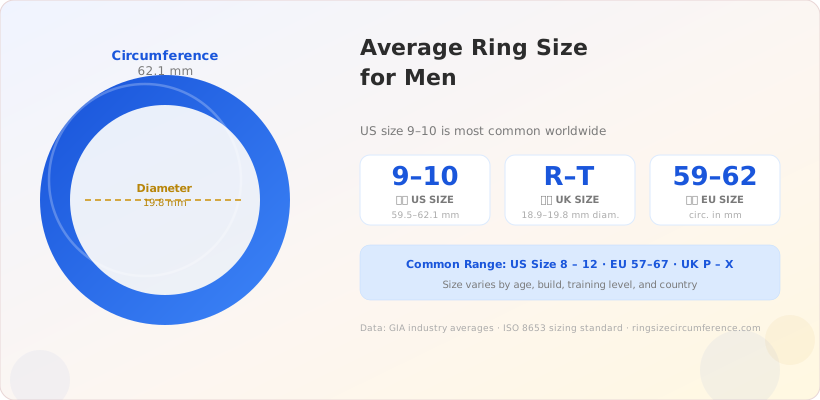
The average ring size for men in the US is size 9 to 10, with size 10 being most commonly purchased. This equals EU 59–62, UK R–T, and an inner circumference of 59.5–62.1 mm. Most men fall between US size 8 and 11, depending on body build and which finger is being sized.
Men's Ring Size Chart — US, UK, EU, JP & Measurements
This table covers the full range of men's ring sizes from US 7 to 13, with circumference and diameter in both mm and inches. Values match the main ring size chart on this site, ensuring consistency across all pages.
| US Size | UK Size | EU / DK | JP Size | Circ. (mm) | Diam. (mm) | Circ. (in) | Diam. (in) |
|---|---|---|---|---|---|---|---|
| 7 | N | 54 | 13 | 54.4 | 17.3 | 2.14 | 0.68 |
| 7.5 | O | 55 | 14 | 55.7 | 17.7 | 2.19 | 0.70 |
| 8 | P | 57 | 15 | 57.0 | 18.1 | 2.24 | 0.71 |
| 8.5 | Q | 58 | 16 | 58.3 | 18.5 | 2.29 | 0.73 |
| 9 ★ | R | 59 | 18 | 59.5 | 18.9 | 2.34 | 0.74 |
| 9.5 | S | 60 | 19 | 60.8 | 19.3 | 2.39 | 0.76 |
| 10 ★ | T | 62 | 20 | 62.1 | 19.8 | 2.44 | 0.78 |
| 10.5 | U | 63 | 21 | 63.4 | 20.2 | 2.50 | 0.79 |
| 11 | V | 64 | 22 | 64.6 | 20.6 | 2.54 | 0.81 |
| 11.5 | W | 65 | 23 | 65.9 | 21.0 | 2.59 | 0.83 |
| 12 | X | 67 | 25 | 67.2 | 21.4 | 2.64 | 0.84 |
| 12.5 | Y | 68 | 26 | 68.5 | 21.8 | 2.70 | 0.86 |
| 13 | Z | 69 | 27 | 69.7 | 22.2 | 2.74 | 0.87 |
★ Most commonly purchased men's ring sizes in the US. Full chart with all sizes from US 3: main ring size chart. View in centimetres: ring size chart in cm.
Common Average Men's Ring Sizes
The average ring size for men is not a single number — it's a range that shifts based on where you are in the world, your body type, and which finger you're measuring. Here's what the data shows.
Average Men's Ring Size by Body Type
Body build is the most reliable predictor when estimating the average ring size for men without a physical measurement's ring size short of actually measuring. The table below provides practical estimates based on combined height and build — useful when buying a surprise gift or when a physical measurement isn't possible.
| Build | Height Range | Weight Range | Likely US Size | EU Equiv. |
|---|---|---|---|---|
| Slim / Small Frame | Under 5'8" | Under 150 lbs | 7 – 9 | 54 – 59 |
| Average Build | 5'8" – 5'11" | 150 – 185 lbs | 9 – 10.5 | 59 – 63 |
| Average-to-Large | 5'10" – 6'1" | 180 – 210 lbs | 10 – 11.5 | 62 – 65 |
| Large Frame / Muscular | Over 6' | 210 – 260 lbs | 11 – 13 | 64 – 69 |
| Very Tall / Heavy Build | Over 6'3" | Over 260 lbs | 12 – 14+ | 67+ |
Estimates only — always measure the actual finger before buying. Muscle mass increases size independently of weight.
Average Men's Ring Size by Finger
The ring finger is not necessarily the most average finger on a man's hand. Each finger differs in circumference, and the differences can be significant — especially between the ring finger, middle finger, and thumb.
| Finger | Typical US Size | Notes |
|---|---|---|
| 👍 Thumb | 10 – 13 | Largest finger; often 3+ sizes above ring finger |
| 👆 Index / Pointer | 9 – 11 | Typically 1–2 sizes larger than ring finger |
| 🖕 Middle Finger | 9.5 – 11.5 | Often the widest finger on the hand |
| 💍 Ring Finger | 8.5 – 10.5 | Standard engagement/wedding ring placement |
| 🤙 Pinky | 6 – 8.5 | Smallest finger; signet rings, fashion rings |
Average Men's Ring Size by Age
The average ring size for men increases gradually with age — primarily due to changes in body weight, joint size, and skin elasticity. Unlike women, men don't experience pregnancy-related fluctuations, so their sizing trajectory tends to be a slower, more linear progression.
- Late teens to mid-20s: US size 8 to 9.5 — fingers are still developing, often at their slimmest
- Late 20s to 30s: US size 9 to 10.5 — the most common range; typical adult size settling point
- 40s to 50s: US size 10 to 11.5 — gradual increases from weight changes and joint enlargement
- 60s and beyond: US size 10.5 to 12 — arthritis, bone changes, and weight shifts are common factors
Understanding Men's Ring Sizes
Understanding the average ring size for men starts with knowing how the sizing systems work — men's ring sizing uses the same underlying measurement scales as women's — the US numerical scale, UK letter scale, EU circumference-based scale, and JP numerical scale. What differs is where most men fall within those systems, and some important practical considerations specific to men's rings.
Ring size is determined by the inner circumference of the ring — the measurement around the inside of the band. A US size 10, for example, has an inner circumference of exactly 62.1 mm. The size number itself has no intuitive meaning; it's an arbitrary label mapped to a specific circumference value. The EU system is more logical — EU size 62 means a ring with a 62 mm inner circumference. For the full measurement reference, see our ring size circumference chart.
One thing that makes men's sizing practically harder than women's: men are less likely to own existing rings they can measure as a reference. Women often have several rings already sized, making it easy to find a comparable size. Many men buying their first ring have no reference point at all, which means measurement from scratch — wrapping paper around the finger — is essential rather than optional.
For instant conversion across all systems, enter your circumference or diameter measurement in the ring size calculator — it accepts mm, cm, and inches.
Factors That Affect Men's Ring Size
Several factors drive the wide variation in men's ring sizes. Some are predictable from body type; others — particularly physical activity — are genuinely surprising in how much they can shift finger size over time.
Hand Dominance and Lateral Asymmetry
For the average ring size for men on each hand, dominance matters: a man's dominant hand is consistently larger than his non-dominant hand — by an average of half a US ring size. This is caused by greater muscle development in the forearm and hand from years of preferential use. Right-handed men who plan to wear a ring on their left hand (as with most Western wedding ring traditions) will typically need a slightly smaller size on the left than they would on the right. This difference should always be measured rather than assumed — the gap varies considerably between individuals.
Knuckle Proportions in Men
Men have proportionally more variable knuckle-to-base ratios than women. Men who do significant manual work often develop pronounced knuckle enlargement — particularly in the index and middle fingers — which creates a situation where a ring sized to pass over the knuckle will spin loosely at the base. This is a more common problem for men than the sizing data suggests, because rings that don't fit in this way are often not returned — they're simply not worn daily.
Height, Weight, and Body Composition
Weight is the strongest anthropometric predictor of men's ring size, but the type of weight matters. Men carrying primarily adipose tissue (body fat) tend to have softer, fuller fingers that increase proportionally with weight. Men who carry primarily muscle mass — especially in the hands and forearms from weightlifting or manual work — often have smaller, denser fingers relative to their total body weight, because muscles pack more tightly than fat. Two men of identical height and weight can differ by 2 full ring sizes if one is heavily muscled and the other carries more body fat.
Weightlifting and Gym Training
Weightlifting is a factor almost no ring sizing guide mentions when discussing the average ring size for men — but it's one of the most relevant for the significant portion of men who train regularly. Exercises that build forearm and hand grip strength — deadlifts, pull-ups, barbell rows, farmer carries — hypertrophy the muscles of the hand and forearm, which directly increases the circumference of the fingers. Men who begin serious resistance training often find that rings bought before they started training no longer fit comfortably 12–18 months later. The increase is typically half to one full US size, though dedicated grip athletes can see larger changes. If you're planning to start or continue serious training, consider sizing at your anticipated training weight and factoring in a half-size buffer.
Manual Labour and Physical Work
Physical occupation also shifts the average ring size for men considerably. Those who work with their hands professionally — construction workers, mechanics, carpenters, farmers — typically have noticeably larger hands and fingers than office workers of the same body weight. Years of gripping tools, using hand equipment, and physical exertion builds the intrinsic muscles of the hand in a way that increases ring size independently of general body size. A tradesman and an office worker of identical height and weight could differ by a full US ring size in the ring finger.
Ring Width and Comfort Fit
Men's wedding bands and fashion rings are typically wider than women's — commonly 6–10 mm versus 2–4 mm. This matters for sizing because a wider band covers more of the tapered section of the finger, creating more contact with the skin and making the ring feel tighter than a thin ring of the same inner diameter would. As a practical rule for men: add half a US size for every 2 mm of band width above 6 mm. A 10 mm wedding band should be sized approximately 1 full US size above your measured ring finger circumference to achieve the same wearing comfort as a standard 4 mm band.
International Ring Size Differences for Men
Men's ring sizing varies by country not because fingers are different internationally, but because the labelling systems are completely incompatible. A "size 10" means something different in the US, UK, Europe, and Asia. Here's what the average ring size for men looks like expressed in each major system.
United States & Canada
Numerical scale. Average men's size: US 9 – 10. Typical full range: US 8–12. Sizes above 13 are considered specialty and less widely stocked in mainstream retailers.
United Kingdom
Letter scale. Average men's size: UK T – T½. Typical range: R to V. UK size T equals US size 10 exactly. Ring sizes above Z require specialist ordering from most UK jewellers.
Europe (EU / DK)
Circumference in mm. Average men's size: EU 62. Typical range: EU 59–65. The EU number equals the inner circumference in mm — EU 62 means a 62 mm inner circumference. The most logically transparent system internationally.
Australia
Same letter system as UK. Average men's size: T – T½. Australian men run very close to the UK average. US size 10 = UK/AU T = EU 62. Australian jewellers typically stock up to size Z; above that requires custom ordering.
East Asia (JP / China / HK)
Japan uses a separate numerical scale. Average men's size: JP 18 – 20, equivalent to US 9–10. East Asian men on average have smaller finger profiles than Western averages, so stock sizes in Asian retail tend to stop at US size 11–12 equivalents.
India & South Asia
Indian numerical scale. Average men's size: Indian 19 – 22, approximately US 9–10.5. The Indian scale is also used in Pakistan, Bangladesh, and Sri Lanka. Always verify against circumference in mm when buying cross-border.
For precise cross-system conversion, use our ring size calculator — enter your measurement in mm, cm, or inches and get your size in US, UK, EU, and JP simultaneously. Our ring size chart in cm includes a men's section with all sizes expressed in centimetres.
What Makes Men's and Women's Ring Sizes Different?
The gap between the average ring size for men and women is roughly 3 to 4 US sizes — but the difference runs deeper than just a number. The practical and anatomical reasons behind it affect how rings are designed, sized, and worn.
Men's vs Women's Ring Size Comparison
| Measurement | Men (Average) | Women (Average) | Difference |
|---|---|---|---|
| US Ring Size | 9 – 10 | 6 – 6.5 | ~3–4 sizes |
| UK Ring Size | R – T | L – N | ~6 letters |
| EU Size | 59 – 62 | 51 – 54 | ~8–10 mm circ. |
| Circumference (mm) | 59.5 – 62.1 | 51.9 – 53.1 | ~7–9 mm |
| Diameter (mm) | 18.9 – 19.8 | 16.5 – 16.9 | ~2–3 mm |
| Typical Band Width | 6–10 mm | 2–4 mm | 3–6 mm wider |
Men's fingers are on average about 7–9 mm larger in circumference than women's — roughly the diameter of a pencil. This difference compounds with ring width: men's bands are typically 3–6 mm wider than women's, which means the sizing adjustment for band width (going up half a size per 2 mm above 4 mm) applies far more often and more significantly in men's jewellery.
For a detailed breakdown of women's ring sizing including regional data and finger-type variations, see our companion guide on the average ring size for women.
Best Rings for Men — Sizing Considerations by Style
Different ring styles have specific sizing requirements that go beyond the standard measurement. For men specifically, the choice of material and band style has significant implications for both the size you should order and your ability to resize later.
Men's Wedding Bands
The average size for men's wedding bands in the US is size 10, matching the general average ring size for men. However, the wide band standard in men's wedding jewellery (typically 6–10 mm) means most men should order half to one full size above their measured ring finger circumference. Wedding bands are worn every day for decades — sizing slightly larger rather than tighter is the right long-term choice, particularly since men's fingers tend to grow larger with age.
The most common men's wedding band materials are tungsten, titanium, gold, platinum, and silver. Of these, tungsten and titanium cannot be resized — they must be replaced if the fit changes. Gold (yellow, white, and rose gold) and platinum can be resized up or down by most jewellers. If you're uncertain between two sizes, choose the larger one if the band is tungsten or titanium, and the smaller one if it's a resizable metal — easier to size down gold than up.
Gold Rings for Men
Gold is the most popular ring metal for men globally, spanning everything from simple wedding bands to signet rings and fashion jewellery. Gold bands in 18k and 14k can be resized by most jewellers, which gives more flexibility at the point of purchase. Yellow gold is the most traditional; white gold and rose gold have grown significantly in popularity for men's jewellery over the past decade.
One important sizing note for gold: thick gold bands (over 3 mm in depth, not width) feel stiffer and slightly more snug than thin bands of the same inner diameter. This is a tactile perception issue — the mass of the gold pressing against the finger creates a sensation of tightness even when the inner measurement is correct. Men new to wearing gold rings often size up by half after their first week of wearing.
Signet Rings
Signet rings are traditionally worn on the pinky finger, where men's average sizes range from US 6 to 8.5. Pinky sizing is dramatically different from ring finger sizing — often 2 to 3 full US sizes smaller. Men who assume their ring finger size applies to the pinky will consistently order too large. Always measure the specific finger intended.
Smart Rings and Fitness Trackers
Smart rings — including the Oura Ring, Samsung Galaxy Ring, and similar health monitoring devices — use ring size for sensor fit accuracy. An ill-fitting smart ring doesn't just feel uncomfortable; it produces inaccurate health data. These devices typically come with sizing kits: a set of plastic trial rings in different sizes to wear for 24–48 hours before ordering the final device. This is the correct approach — do not estimate or use a standard jewellery size. Smart rings from most manufacturers top out at size 13 (US); larger fingers are not currently well-served by the category.
Wide Fashion Rings and Statement Pieces
Men's fashion rings — wide bands, carved designs, statement pieces worn on the index or middle finger — often require a size 1 to 1.5 above the measured circumference due to their width and the fingers they're worn on. Index finger rings in particular often require US size 9–11 for men, as the index finger is typically 1–2 sizes larger than the ring finger. The middle finger often requires the largest size of any finger except the thumb.