
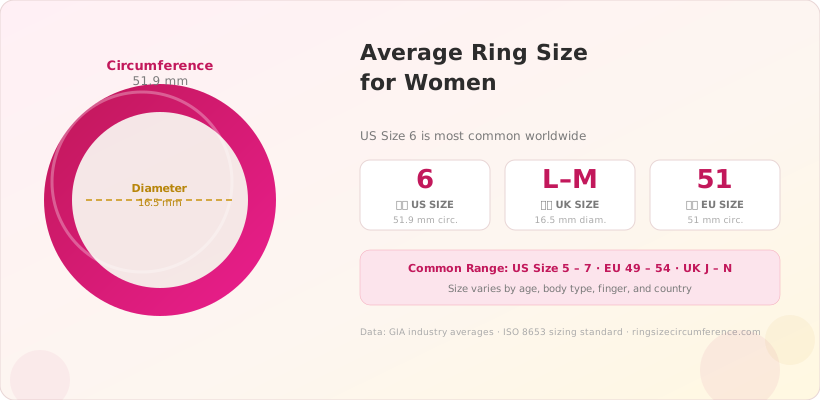
The average ring size for women in the US is size 6 to 6.5 (EU 51–53, UK L–M, inner circumference 51.9–53.1 mm, inner diameter 16.5–16.9 mm). Globally, most women fall between US size 5 and 7 depending on region, body type, and the specific finger being sized.
What Is the Average Ring Size for Women?
The average ring size for women in the United States is size 6, with sizes 5 through 7 covering the range worn by the majority of American women. The GIA — the most widely recognised authority in the jewellery industry — cites size 6 as the single most commonly ordered women's ring size in US retail, with size 6.5 running a close second.
What those statistics don't reveal is how wide the true distribution is. Women routinely wear sizes from 4 to 9 — a range of 5 full US sizes. The sections below explain why that variation exists and what it means practically for buying or sizing a ring.
Average Ring Size for Women — Quick Reference
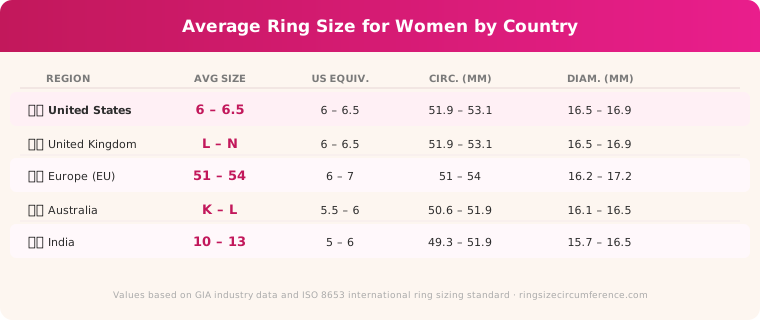
| Region | Average Size | US Equiv. | Circ. (mm) | Diam. (mm) |
|---|---|---|---|---|
| 🇺🇸 United States | 6 – 6.5 | 6 – 6.5 | 51.9 – 53.1 | 16.5 – 16.9 |
| 🇬🇧 United Kingdom | L – M | 6 – 6.5 | 51.9 – 53.1 | 16.5 – 16.9 |
| 🇪🇺 Europe (EU) | 51 – 53 | 6 – 6.5 | 51 – 53 | 16.2 – 16.9 |
| 🇦🇺 Australia | K – L | 5.5 – 6 | 50.6 – 51.9 | 16.1 – 16.5 |
| 🇮🇳 India | 10 – 13 | 5 – 6 | 49.3 – 51.9 | 15.7 – 16.5 |
| 🌏 East Asia | JP 9 – 10 | 5.5 – 6 | 50.6 – 51.9 | 16.1 – 16.5 |
These are averages based on jewellery industry data and regional sizing surveys — not absolute rules. Individual variation is enormous. Always use actual measurements rather than assuming the average applies to any specific person. To find your exact size, use our ring size calculator or the measurement guide on our homepage.
Why the Average Ring Size for Women Isn't the Same for Everyone
The idea that there's one "standard" women's ring size is one of the most persistent myths in jewellery. In reality, finger size is the result of genetics, body composition, lifestyle, regional diet patterns, and even climate — all interacting differently in every individual.
Consider two women both aged 32 and both 5'5" tall — one may wear a size 4.5 and the other a size 8. The difference comes down to bone structure, fat distribution in the fingers, whether they work manually, how their fingers respond to temperature, and which finger they're sizing.
Online averages — including the widely quoted "US size 6" — are calculated from jewellery purchase data. This means they reflect what women most commonly buy, not necessarily what size most women actually are. Women with very small or very large fingers are less likely to find rings that fit off-the-shelf, so they buy less frequently, slightly skewing the data toward the middle.
Factors That Affect Women's Ring Sizes
Understanding what drives finger size variation helps you estimate someone's size more accurately — and explains why your own size may have changed over the years.
Hand Dominance
Your dominant hand — the one you write and work with — is typically half a US size larger than your non-dominant hand. This happens because repeated use of the dominant hand builds slightly more muscle and increases blood flow, causing the fingers to be marginally thicker. If a woman is right-handed and wears an engagement ring on her left hand, she may need a different size than if she wore it on her right.
Knuckle Size
Many women have a ring finger where the knuckle is noticeably wider than the base of the finger. This is particularly common as women age or in those with naturally prominent joints. For these women, a ring sized to the base will not pass over the knuckle — and a ring sized to the knuckle will spin freely at the base. The practical solution is to size toward the knuckle and use a fitted ring insert or sizing bead to prevent spinning. This is a nuance that a simple "average" completely fails to address.
Height, Weight, and Body Composition
Body frame is the strongest physical predictor of ring size, though it's still imperfect. Here is a practical guide based on combined height and build:
| Build | Height Range | Weight Range | Likely US Size |
|---|---|---|---|
| Petite / Slim | Under 5'2" | Under 120 lbs | 4 – 5.5 |
| Slim / Average | 5'2" – 5'6" | 120 – 145 lbs | 5 – 6.5 |
| Average Build | 5'4" – 5'7" | 140 – 170 lbs | 6 – 7 |
| Larger Frame | 5'6" – 5'10" | 170 – 210 lbs | 7 – 8.5 |
| Tall / Full Build | Over 5'10" | Over 210 lbs | 8 – 10 |
These are estimates only. Genetics can place an individual anywhere regardless of height and weight. Always measure — never rely solely on body type.
Lifestyle and Daily Activity
Women who work with their hands — in healthcare, construction, sport, or manual craft — typically develop slightly thicker fingers than those in sedentary office roles. Repeated gripping and tool use builds the small muscles and tendons in the hand, which can increase ring size by half a size or more compared to someone of the same body weight who does not use their hands heavily.
Ring Type and Band Width
The width of a ring band directly affects how it feels on the finger — even at the correct measured size. A thin 2 mm eternity band sits at the narrowest point of the finger and feels looser. A wide 8 mm band covers more surface area, compresses the skin, and feels snugger. As a practical rule:
- Bands under 4 mm — size exactly as measured
- Bands 4–6 mm — consider half a size up
- Bands over 6 mm — go up half to one full size from your measured size
This is especially relevant for engagement rings paired with wedding bands — the combined width of two rings worn together often requires each individual ring to be half a size larger than if worn alone.
Average Women's Ring Size by Finger
Every finger on the same hand is a different size — sometimes dramatically so. Buying a ring without knowing which finger it will be worn on is one of the most avoidable sizing mistakes. Here are typical size ranges for each finger:
| Finger | Typical US Size Range | Notes |
|---|---|---|
| 👆 Index / Pointer | 6 – 8 | Often larger than ring finger |
| 🖕 Middle Finger | 6.5 – 8 | Typically the largest finger |
| 💍 Ring Finger | 5 – 7 | Most common engagement/wedding placement |
| 🤙 Pinky | 3.5 – 5 | Significantly smaller on most women |
| 👍 Thumb | 6.5 – 9 | Widest finger; thumb rings need special sizing |
Average Ring Size for Women with Small Hands
Women with petite or small hands — typically those under 5'2" with a slim build — most commonly wear US sizes 4 to 5.5. What's often overlooked is that "small hands" doesn't automatically mean small knuckles: some petite women have relatively large knuckles compared to their finger base, which means they need to size differently than the number on their ring finger alone would suggest.
Average Ring Size for Women with Chubby Fingers
Women with fuller or rounder fingers often find that standard sizing charts underestimate their size. Fingers that appear chubby may have a smaller-than-expected circumference at the base but a much larger knuckle — or vice versa. If in doubt, measure at both points and choose a size that passes over the knuckle comfortably, using a ring insert at the base if needed.
Women's Average Ring Sizes Around the World
Ring sizing systems differ by country, which creates confusion when buying internationally. The underlying finger measurements are the same globally — only the labelling system changes. For full conversion details, see our complete ring size circumference chart or the ring size chart in cm.
United States & Canada
Uses a numerical scale. Average women's size: US 6 – 6.5. The most common engagement ring size ordered is US 6. Sizes 5 through 7 cover the vast majority of American women.
United Kingdom
Uses letters A–Z with half sizes. Average women's size: UK L – N. UK size L equals US size 6 exactly. Engagement ring average is UK L; wedding band average is also UK L.
Europe (EU / DK)
Uses a number equal to the inner circumference in mm. Average women's size: EU 51 – 54. EU 52 = US 6.5. The EU system is the most transparent — the number is the measurement.
Australia & New Zealand
Uses the same letter scale as the UK. Average women's size: K – L. This is slightly smaller than the UK average, reflecting a difference in population body composition data used by major Australian jewellers.
India
Uses a numerical scale distinct from the US system. Average women's size: Indian 10 – 13, equivalent to US size 5 to 6. Indian sizing is common across South Asia including Pakistan, Bangladesh, and Sri Lanka.
East Asia (JP / China / HK)
Japan uses a numerical scale. Average women's size: JP 9 – 11, equivalent to US size 5.5 to 6.5. East Asian women on average have slightly slimmer finger profiles than Western averages, though individual variation is wide.
Smart Ways to Find Your Partner's Ring Size Without Asking
Whether you're planning a proposal or buying a gift, these methods let you determine someone's ring size discreetly and ethically. They're ordered from most to least accurate.
Borrow a Ring She Already Wears on That Finger
The most reliable method. Borrow a ring she regularly wears on her ring finger — even for an hour. Trace the inner circle on paper or press it gently onto soft soap to get an impression. Measure the inner diameter with a ruler and match it to the ring size chart. Return it immediately and say nothing.
Check Her Jewellery Box for a Sized Ring
Many women own at least one ring they already know the size of. If she has any rings in a jewellery box — especially one bought recently at a reputable jeweller — it may have a size stamped inside the band. Even if the stamped ring fits a different finger, it gives you a useful starting reference.
Ask a Trusted Friend or Family Member
A best friend, sister, or mother may already know her ring size — especially if they've shopped for jewellery together. This approach works particularly well if the trusted contact is sworn to secrecy and has the social awareness to ask naturally ("oh, what size rings do you usually wear?") without raising suspicion.
Estimate Based on Body Type and Finger Shape
Use the height and weight guide in this article as a starting point. Then observe her hands — slender fingers with visible tendons suggest a smaller size; rounder fingers suggest larger. If she's average build (5'4"–5'6", 130–160 lbs) with slim fingers, US 6 is a reasonable estimate. Remember to account for the specific finger she'll wear the ring on.
Compare Her Finger to Your Own
Hold her hand casually and note where your own knuckle or finger base aligns with hers. If you know your own ring size and her finger appears similar, you have a baseline. This is imprecise but combined with other clues, it can confirm or contradict a size estimate.
Buy Slightly Larger and Plan to Resize
When all else fails, buy half a size larger than your best estimate. Most reputable jewellers offer one free resize — confirm this before purchasing. A ring slightly too large can be temporarily kept in place with a ring guard or sizing insert, and resized at leisure after the proposal without pressure.
Women's vs Men's Ring Sizes — Key Differences
Understanding the gap between typical women's and men's ring sizes is useful context — especially when buying matching sets or trying to estimate a partner's size based on your own.
The average ring size for men in the US falls between size 9 and 10 — roughly 3 full sizes larger than the average women's size of 6. This reflects differences in bone structure, muscle mass, and overall hand size between men and women on average. Men also typically prefer wider bands (6–8 mm vs women's 2–4 mm average), which affects perceived fit.
👩 Women's Average
US 6 – 6.5 · EU 51–53 · UK L–M
Circumference: 51.9–53.1 mm
Preferred band width: 2–4 mm
Common finger: ring finger, left hand
👨 Men's Average
US 9 – 10 · EU 59–62 · UK R–T
Circumference: 59.5–62.1 mm
Preferred band width: 6–8 mm
Common finger: ring finger, left or right
The size gap between a couple's rings is typically 3 to 4 US sizes. If one partner wears a size 6, the other commonly wears size 9 to 10 — though exceptions are common. A detailed guide to the average ring size for men — including variation by finger type, body build, and region — will be covered in a dedicated upcoming article.
Why Getting the Right Size Matters
Beyond comfort, ring size accuracy has real practical and financial implications — particularly for engagement rings and wedding bands that are intended to be worn every day.
- Resizing costs money: Most jewellers charge $20–$100 for a resize, and some ring styles — those with channel-set stones all around, or made in titanium, tungsten, or ceramic — cannot be resized at all. Getting the size right the first time saves both money and stress.
- Rings that are too tight restrict circulation: A ring even half a size too small can cause swelling, discomfort, and in extreme cases, impair blood flow to the fingertip. This is particularly risky during activities that increase blood flow, like exercise.
- Rings that are too loose get lost: A ring that's a full size too large will slide off during hand washing, exercise, or any activity involving water or oils. Engagement rings are irreplaceable emotionally and often extremely valuable — the risk isn't worth it.
- Comfort affects daily wear: For a ring intended to be worn continuously, even a quarter-size mismatch can cause long-term discomfort. A well-fitted ring should be forgotten once it's on.
If you're ready to find your exact size, use our free ring size calculator — enter your finger circumference or ring diameter and get your size in US, UK, EU, and JP systems instantly.